
In the entire history of Hindu literature and philosophy, no figure has been as deeply studied, as widely worshipped, or as universally admired as Lord Ram. He is called Maryada Purushottam — the Supreme Being of Right Conduct. Not the most powerful god. Not the most fearsome warrior. The one who lived life most correctly. This distinction is what makes Ram unique in the Hindu pantheon and why his story, the Ramayana, has remained relevant across 7,000 years of civilisation.
The Meaning of Maryada Purushottam
Maryada means "boundary" or "principle" — the limits of right conduct. Purushottam means "the best of men." Together, the title means "the one who lived best within the boundaries of righteous conduct." Ram is not worshipped because he was omnipotent — he is worshipped because he chose dharma over personal desire at every turn, even when it came at enormous personal cost.
The Lessons Ram's Life Teaches
1. Honour Your Word Above All
Ram accepted 14 years of exile in the forest because his father Dasharatha had given a word to Queen Kaikeyi. Ram's own claim to the throne was legitimate and supported by everyone in Ayodhya. He gave it up without argument because his father's word had to be honoured. In a world where promises are broken casually, Ram's example is a permanent reminder that integrity is not situational.
2. Duty Before Desire
At every point where Ram faced a choice between personal happiness and duty, he chose duty. He left Sita when his duty as a king required it — the most painful decision of his life. He fought Ravana not out of rage but out of the duty to protect dharma and rescue his wife. The Ramayana teaches that genuine nobility is defined by what you sacrifice, not what you gain.
3. Equality of Heart
Ram ate the half-eaten berries of Shabari, a low-caste tribal woman, because she had tasted each one to check its sweetness before offering it. He embraced Guha, the boatman. He allied with Sugriva and the Vanaras when no one else would. In an age of rigid hierarchy, Ram demonstrated that devotion and love transcend all social distinctions — a teaching that resonates as powerfully today as it did 7,000 years ago.
4. The Warrior at Peace
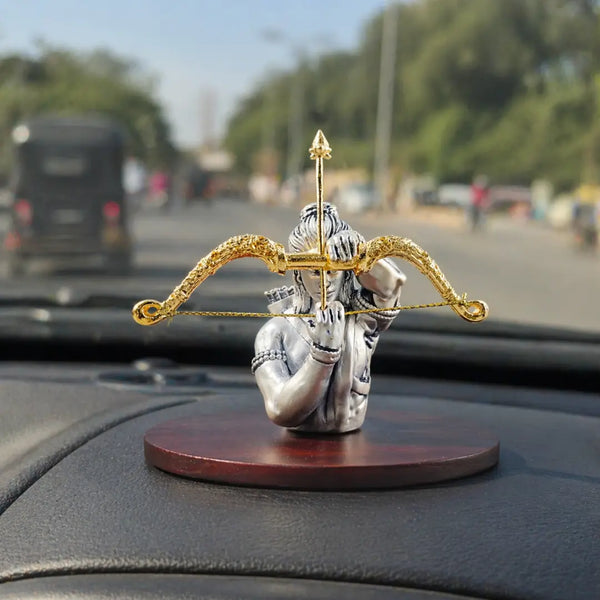
Ram's iconic image — the bow drawn at full stretch, arrow nocked, eyes focused — is the image of a warrior in a state of complete calm. Not anger. Not revenge. The posture of someone fulfilling their duty with total precision and zero emotional distortion. This is the ideal that Indian martial, philosophical and spiritual traditions have pointed toward for millennia: action without ego, strength without cruelty.
5. The Ideal Relationship
Ram's relationship with Sita is considered the gold standard of partnership in Hindu tradition. Mutual devotion, mutual respect, shared suffering, and unshakeable loyalty even across the most extreme circumstances. Ram's love for Sita was not possessive — it was protective. His grief at their separation was genuine and total. The Ramayana is, among other things, the greatest love story in Indian literature.
Why a Ram Idol in the Home Matters
Keeping a Ram idol in the home is not merely a devotional act. It is a daily reminder of these values — integrity, duty, courage, equality, and love. The idol of Ram with his bow drawn at full stretch captures the moment of perfect dharmic action: focused, calm, purposeful, and righteous.
Our silver plated Lord Ram idol — with gold-plated bow and arrow — is available in 4 inch for car dashboards and office desks, and 5.7 inch for home mandirs. The antique matte finish gives it the regal, aged quality that a glossy finish cannot replicate.
Why is Ram called Maryada Purushottam?
Maryada means the boundary of right conduct, and Purushottam means the best of men. Ram is called Maryada Purushottam because he honoured the principles of dharma at every point in his life — even when it caused him great personal suffering. He is worshipped not for his power but for his conduct.
What does Ram's bow and arrow posture represent?
The bow drawn at full stretch represents Ram in the moment of dharmic action — focused, calm, and purposeful. It is the image of strength without ego, the warrior fulfilling his duty with complete precision. This is why this posture is considered the most powerful representation of Ram.
Is Ram Navami the best time to gift a Ram idol?
Ram Navami — the birthday of Lord Ram — is the most auspicious time to gift or receive a Ram idol. It is also appropriate for Diwali (Ram's return to Ayodhya), housewarming, and as a gift for Ram devotees at any time of year.
Also Read
Ram Navami Gift Ideas for Family | Best Gifts for Hanuman Devotees | Shop Lord Ram Idol